Event Details
Academic Dialogue Series, Lecture 1
FROM 27 Nov 2025 TO 27 Nov 2025
Venue : CDOE - SMU @
| Title of Event | Academic Dialogue Series, Lecture 1 |
| Organized By | Research Committee, Centre for Distance and Online Education (CDOE) |
| Under the Banner of | CDOE, Sikkim Manipal University |
| Collaboration With | NA |
| Student Event | No |
| Externally Funded | No |
| Nature of Participants | Both Internal and External |
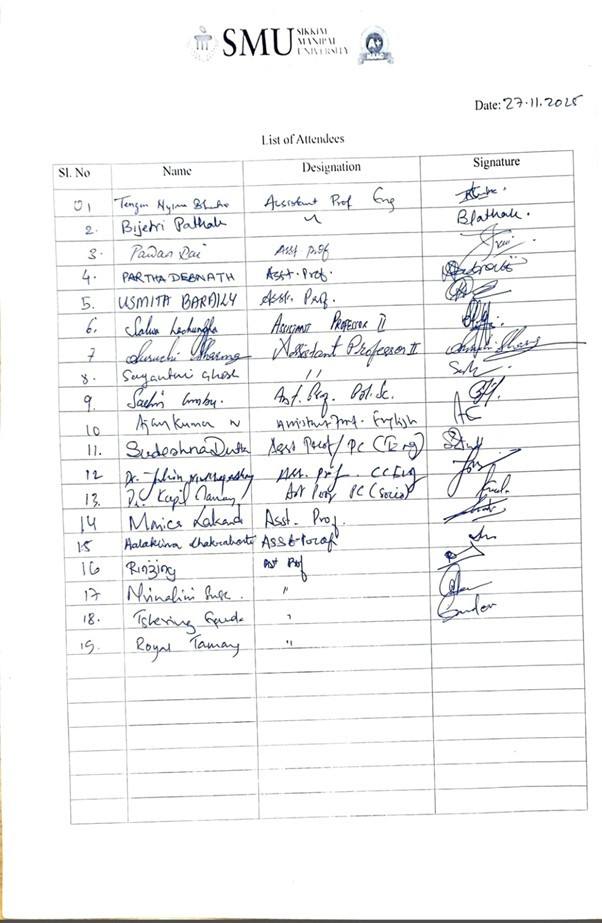
| Total Participants | 19 (Internal: Yes | External: Yes) |
| Mode | Online (Internal & External) |
| Online Meeting Link | Microsoft Teams Meeting Link |
| Date | 27 November 2025 |
| Coordinator | Research Committee, CDOE |
| Participant List Attached | Yes |
Resource Person(s)
| Sl. No. | Name | Affiliation |
|---|---|---|
| 1 | Dr. Kapil Tamang | Assistant Professor, CDOE, SMU |
Brief Description / Report
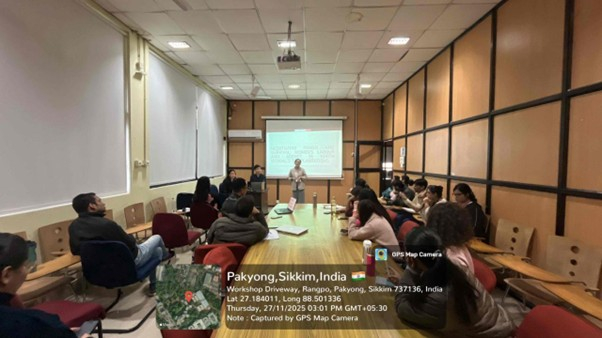
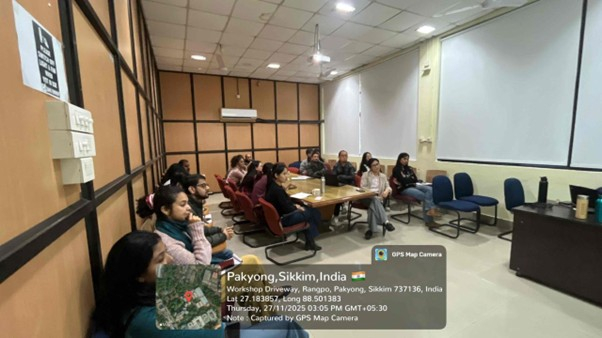
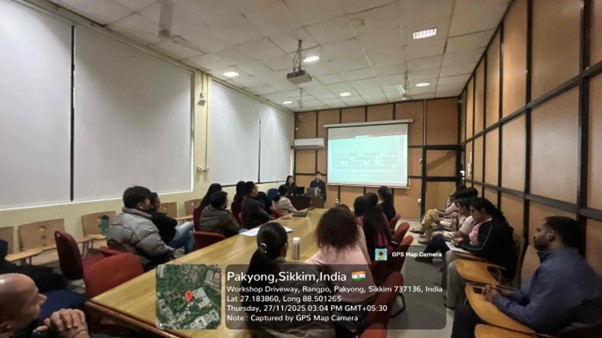
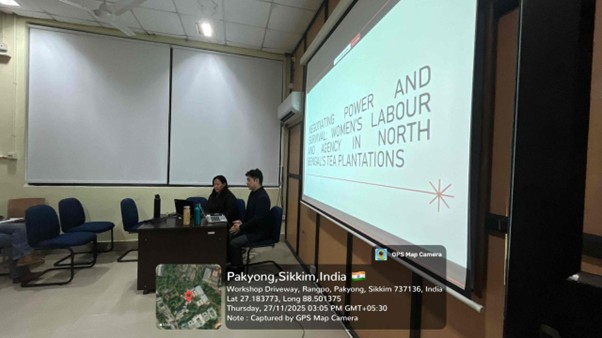
The research talk was organised by the Research Committee as part of the Academic Dialogue Series on 27 November 2025 (Thursday), between 3:00 PM and 5:00 PM. The lecture was delivered by Dr. Kapil Tamang, Assistant Professor, Department of Sociology, CDOE.
The lecture examined how women tea workers in the plantations of North Bengal inhabit the intersection of colonial legacies and contemporary global capitalism. It highlighted how their labour—both productive and reproductive—continues to sustain the tea industry under conditions of persistent undervaluation.
Dr. Tamang discussed the historical and socio-economic context of the tea plantation industry, emphasizing its colonial roots and present-day global economic dynamics. He explained how labour in the tea industry is gendered, with women workers facing economic and social marginalisation.
A key focus of the lecture was on the everyday resistance and agency demonstrated by women tea workers. Drawing on the theoretical framework of Chandra Talpade Mohanty, Dr. Tamang challenged the homogenised portrayal of third-world women as passive victims and showcased their lived realities through his fieldwork in tea plantations.
The lecture concluded with an interactive Q&A session, which saw enthusiastic participation from faculty and staff members of CDOE, reflecting keen interest in the topic.